Monday, March 12, 2012

Mi Madre [Guest Blog]

I was fortunate enough to have my family come to visit in February for a precious 9 days so I could share a quick taste of what my life has been like here in Guatemala before I head out at the end of March. Below are some reflections written by my mother.

***** 

Guatemala is a land of contrasts. The landscape and culture is like an ancient and expertly woven fabric, its drapes and design shaped by volcanoes, water, wind, sea, and her Mayan people. Earth tones prevail: terra cotta reds, sage and forest greens, dusty browns, sky blue, leaden gray. The texture of the weave is deeply carved with steep slopes, high ridges, eroded valleys, and sink holes. The threads of water are precious, even though it falls copiously from the skies in season. There are places where newer threads intersect the old... paved highways that are frayed by mudslides; cell phone towers that rise in spires above the coffee and cardamom groves; glistening plastic litter strewn along the highways. It is as if someone took a look at the ancient weaving and decided to repair the worn spots by stitching in sequins, baubles, and twist ties.

This was most apparent to me as we sat in the main room of our host's house, a room of wooden planking which measured about 12 X 12. The room had two sources of light: the open doorway and a bare incandescent bulb flickering yellow with the fluctuations in power. No windows. Overhead the corrugated tin roof protected us and the family's corn supply from threatening rain, and diverted the water into a plastic lined catchment since no running water is available for miles. A duck was brooding her eggs in one corner of the earthen floored room, while a lame chicken pecked beneath my plastic chair. The three children sat coloring on paper my daughter provided or climbed onto our laps for a game of horsey rides. Meanwhile, our hostess used a rectangular grinding stone and cylindrical pestle carved from volcanic rock to mash the prepared corn into the dough for the fresh tortillas she would cook for us on the wood stove. We sat at a bare, plank table, while she worked at another, methodically grinding the masa, scooping it up, shaping it into tortillas, and deftly depositing them directly onto the hot stove surface. We spoke quietly in English punctuated by exchanges in Q'eqchi' between my daughter and the host family. Suddenly a chirping noise broke the pattering rhythm of the tortilla making, and our hostess turned to a makeshift shelf nailed to the wooden wall by her work table and answered her cell phone. A land of contrasts indeed.

Monday, March 5, 2012

Semuc Champey


In mid-February my site mate and I met up with some other PCVs from our training class and high tailed it to Semuc Champey in Alta Verapaz near Lanquin. We took a fantastic tour both walking and swimming through caves carrying our own candles along for light, and then enjoyed the afternoon above ground admiring the scenery and pools.

It was a beautiful place and I´m only sorry I only got to go once. I´ve already added it to my list of places to return to on my next trip to Guatemala.

Monday, February 20, 2012

Charting a New Course

"You need a plan ... but don't become consumed by it. Winds change."
  -- Joseph Ehrhard 


In mid-January I was in planning mode. I met with the school director in my village to plan for the start of the school year. I outlined my six month plan to cover nutrition with my women's groups. I was anticipating the changeover of half the board of directors in the cooperative, hopefully providing an opening to work with the Agriculture Committee. I was contemplating starting a weekly Junior Master Gardener group and a GLOW camp (Girls Leading Our World) for Holy Week. I was plotting how to best use the rest of my vacation time.

As often seems to be the case in life, and in the Peace Corps in particular, events have torn my best laid plans to shreds. 

The Powers That Be came to Peace Corps Guatemala. After an urgent text message and email, volunteers from all over Guatemala assembled at an All Volunteer Conference in Quetzaltenango (aka Xela) in what felt like a tortuously slow motion scramble. 

Representatives from the national Peace Corps office in DC came and explained in compelling detail that crime and safety are of serious concern in the Northern Triangle of Central America, which has been called the "deadliest non-war zone in the world" (Christian Science Monitor). Surveys of Peace Corps Volunteers in Guatemala show disturbing trends in volunteers' sense of safety and rates of being a victim to crime. They explained that Congress was asking the Peace Corps pretty pointedly, "What are you doing in Central America?" 

We learned that PC Guatemala is not going to be shut down, but that major changes are on the horizon to manage risk here. The number of volunteers in Guatemala must be reduced drastically and immediately. Those scheduled to leave in March will leave in February. Those scheduled to leave in July will leave in March. Everyone in the country may take an early Close of Service should they choose to do so. The remaining volunteers in country will be condensed into the Central Western Highlands.

Since I live in Alta Verapaz (not in the Central Western Highlands), I was given the choice to either take the early COS or take a site change. Again.

At first the hardest thing to swallow was that I was among the volunteers who had to move. Sure, Guatemala is dangerous. Sure, the murder rate is startlingly high and the impunity from prosecution is sickening. But I feel safe in my site. Everyone knows me. It's a tiny place. I rarely leave my village, and when I do I have access to tourism shuttles and relatively safe bus lines. I spent several days in denial, mentally bargaining for an exception. Surely I could stay here to finish out my service. It took a sympathetic but firm response from my Country Director before I accepted that there was no Option C. I had to choose between going home and going to a new community within Guatemala.

I chose the Peace Corps as my means of volunteering abroad for many reasons, but a huge one was that it allowed me to spend two full years in a community. I felt that in sustainable development, it was important to commit to being somewhere long enough to really know the people, recognize the needs, and take the time to do things well. Having already taken a site change when my initial site placement did not pan out, another would mean my 27 months would end up being 3 months of training, seven months in Solola, ten months in Alta Verapaz, and then seven more months in an unknown location. That sounded exhausting, ineffective, and frustrating.

Yet, I didn't immediately close that door. I wanted to know what the site change might mean. I thought maybe I could be placed somewhere a little more like a job than the usual Peace Corps location. Maybe I could work with an international organization that already had a program in place and just needed help carrying it out. Perhaps I could spend the rest of my service solidifying my Spanish skills and getting a new flavor of work experience.

Once I got back to site, I tried to imagine a new path for myself in Guatemala. I couldn't muster much excitement for it. Going to a new site would overshadow the rest of my time in Alta and likely mean leaving my current site sooner than a COS would. Site development is a complex process even when not rushed, and there was no guaruntee of being sent somewhere I could hit the ground running, or even walking. Going to a site focused on something specific I wanted to get out of the experience rather than on what I could learn and then contribute seemed like a recipe for disappointment. It also runs contradictory to my approach to Peace Corps. A site change felt like a big gamble, but somehow I kept trying to talk myself into taking it. Somehow because I was more apprehensive about staying in Guatemala than going back to the US it felt like that was the bolder, better, or braver choice. Mostly I couldn't let go of my plan of serving my 27 months and finishing out with the rest of my training group.

I realized that what was holding me here was pretty much pure stubbornness, and that made the decision. On February 1, I called my program director and told him I am heading to the States at the end of March. Time to close out this life chapter as best I can and to look inside for what I will bring to the next.

Friday, February 3, 2012

Soap [Success]

Months ago, a group of women in another aldea (village) asked that my site mate and I teach them to make soap. We agreed, and went through a series of hygiene charlas (talks, trainings, activities...) with them as we did the research to teach ourselves how to make it and how to manage the logistics of doing it with them in their community.

At first we gathered the supplies and tried doing it on our own to iron out any kinks in the process. Good thing, too, because we were going based on phoned in advice from another volunteer, and something crucial was lost in the process and our soap did not turn out. At all.

So we jumped through some hoops to import our very own soap making expert volunteer to show us how it was done. It turned out that we'd done everything right, but just needed to stir a little faster, and voila! Success!


Day 1:  Boil 5 gallons water.  Mix it with 5 gallons used oil (we bought from a fried chicken place).  Add 7 bottles of lye.  Mix rapidly stirring only clockwise for one to three hours, until the mixture is thick enough that it doesn't drip off your stirring stick when it is pulled out.  Cover the mixture, let it set for 24 hours in a cool dry location.


Our cautionary warnings of wearing protective materials (left) 
and the steps to make soap on the first day (right).


Our host, Maria, all suited up to take her turn at stirring.


I stirred with another woman, so she could get the idea of the speed and rhythm needed.


My site mate whipping up the mixture toward the end of the process.


Our soap, left to set up over night.


Day 2:  Uncover the soap and pour off any excess oil that remains in the mixture. If the soap set hard, cut it into bars/chunks and wrap them in newspaper.  If the soap remains like a cookie dough texture, ball it up and wrap it in newspaper.  Leave wrapped in a cool, dry location for 4-6 weeks to cure.


It felt wonderful to finally be able to deliver on our promise. To successfully make it through the two day soap making process while teaching in Q'eqchi'. And, to share a bit of our site with a friend from training.

Friday, January 27, 2012

Harvest [Coffee]


Coffee beans started turning from green...


...to red in November... 


...causing another round of harvesting.


Since what gets picked is color coded, the kids and I got to be involved.


The goods get put into large costal bags which the men haul...


...to the cooperative to be weighed.  
They often carry 100-200 pounds worth of product for kilometers over steep, muddy, treacherous terrain...


...and then up the cooperative hill....


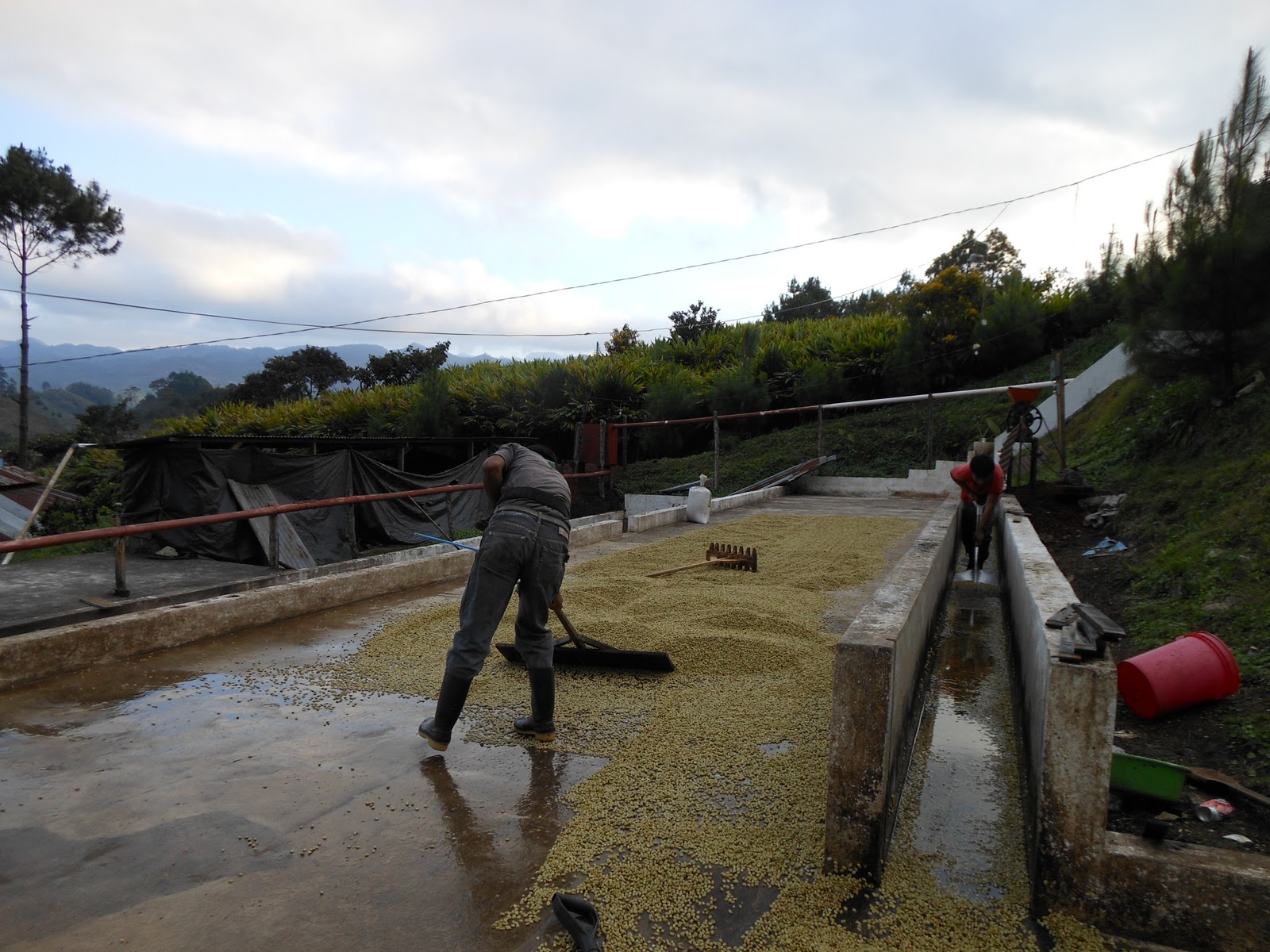
...to be de-pulped...


...washed...


...and sorted by quality.

The high quality stuff gets sold and exported, the low quality stays in the community to be toasted and consumed in heavily sweetened mugs at every meal.

Monday, January 23, 2012

Harvest [Cardamom]

The Cardamom harvest got under way in October, and has been going strong ever since.


A typical house surrounded by cardamom fields.


The tops of the plants are big reaching leafy fronds, 
at the base are the flowers and seed pods.


Although they look the same from the outside, some pods are ready to pick (those with the black seeds) and some are still immature (those with the white). Those in the know go through and invariably pluck the ones with black, coming back through two to three weeks later to get the next round of ripe cardamom further down on the stem.


It's tiring work, requiring bending over to the ground to reach the seed pods.


Once picked, they are gathered together and taken to the cooperative...


...where they are bought and put into huge wood-fired driers. Once dry, the coop sells the "pergamino" abroad where it is processed. I haven't met any Guatemalans who have tasted cardamom, despite it being the main income in my community and many villages in my area.  

I bought some cardamom while home in the States for the holidays. 
If anyone knows a simple recipe using cardamom, please post it in the comments. 
I'd love to share the flavor with my host family and the women in my cooking groups.


Friday, January 20, 2012

Vacation [Stateside]

In December I went to California for the holidays. My parents, sister, and future brother-in-law all flew in, and we saw my grandparents, two sets of aunts and uncles and some cousins on my dad's side of the family. It was the first time I have spent with family and my first time in the States since August 2010.

The whole experience was surreal in that it felt so very normal. After such a long absence I somehow expected it to be hard to pick up where I had left off, but that's the nature of family at its best; the important things don't change, and the things that do change all get rolled into the mix with good cheer. We ate, drank, laughed, cried, celebrated, lazed, and worked where appropriate. I walked the beach, visited the Monarch butterfly grove, went sea kayaking, took a trip to admire the opulence and finery at Hearst Castle, did some wedding dress shopping with my sister, and met my cousin's new little baby.

There were two moments that particularly struck my Guatemalan sensibilities.


Moment 1: Scarcity and Abundance

When I arrived in Texas to change flights, I went through customs and with a thrill filled up my water bottle from the drinking fountain. Free, cold, drinkable water. I hadn't realized that I needed to go through security again to board my new flight. I approached the line and a TSA agent told me I needed to dump out my bottle. I stared at him. At my mostly full Nalgene. Quailed at the waste. Considered chugging the whole thing there and then.

Mentally I knew that there was another drinking fountain on the other side of the security scanners, ready to dispense more free, cold, drinkable water. I knew that we use potable water to flush toilets in the US. This wasn't a huge deal. Emotionally, I reacted as someone who lives in a community that subsists on captured rain water, where I bring in drinkable water from the nearest city and where the dry season means limited bathing, laundry, and dishes.

I looked at the garbage can where he pointed. Took one swallow of water. Poured it out. Went on.


Moment 2: Serenity and Anxiety

One evening at my grandparents house my uncle announced he was heading back to the hotel for the evening. On foot. After dark. Someone offered to drive him, but he shrugged it off and said he'd enjoy the exercise on such a nice night.

My stress level spiked. My stomach tied into knots. I reminded myself we were not in Guatemala, and that pick-pockets, muggers, and kidnappers were hardly likely to target my uncle in a sleepy little beach town in California.

He left, spent the night in the hotel, and arrived back at the house the following morning without incident.  


At the end of the vacation, I mistily hugged each family member, content that at least this time I know I'll be seeing them all again much more quickly than the last span of 16+ months apart. I had a great little bonus visit with a childhood friend who was also vacationing in San Francisco, and then made the trip home to Guatemala.

I stepped back into my life here without much thought, again, things felt surreal in that they felt so normal. How can I comfortably inhabit  the world of Scarcity and Anxiety, as well as Serenity and Abundance? In the US airports I made small talk with strangers, sat between iPad and laptop users while I happily read on my Kindle, and took out my wallet without a second thought as I swiped purchases on my credit card. In the Guatemalan airport I smoothly picked up my defensive living habits of hiding valuables, stowing cash all over my body, and judiciously choosing who to make eye contact with or smile at.

As I walked down the muddy path to the house I share with my host family, my three host siblings shouted my name and ran to me to help carry my bags. I stumbled over the Q'eqchi', but it came out alright. Canchita meowed plaintively at me while I fumbled with the keys, but one look at her plump self assured me she was by no means neglected in my absence. In the evening I walked into the kitchen with my glass of water and tore into the fresh tortillas, easily using them in place of silverware to ferry food to my mouth. Sometimes I wonder what it is I am accomplishing here, but at the very least, I have made a home.

Monday, November 21, 2011

It’s All Q’eqchi’ To Me


I have now been struggling to learn a Mayan language for a year. Admittedly, I spent five or six months working on K’iche’ and then in June switched over to Q’eqchi’. Moving from one language to the other felt how I imagine it would be to switch from Spanish to Portuguese after taking only one semester. The pronunciation is mostly (but not wholly) the same, the grammar is similar, and there are just enough vocabulary words that are the same to keep you confused. My first teacher had almost no experience teaching K’iche’ and so was long on patience but short on structure; my current teacher has been teaching Q’eqchi’ for over a decade and is long on structure but somewhat set in her ways. My class sessions are dominated by me filling my notebook with dictations from my teacher on vocabulary and grammar, but very little verbal practice. Still, living in the community gives me opportunity for practice and most of the fault for my slow progress is my own lack of discipline to study.

In the beginning, the most difficult thing for me was learning to distinguish between different consonant sounds, and to then be able to make them accurately. In Q’eqchi there are six different letters that can make a sound like a “k” to the untrained ear.
  • Q – Sounds like you’re clearing your throat
  • Q’ – A click in the back of the throat
  • K – Sounds like a normal English “ck”
  • K’ – A forceful sound off the roof of the mouth
  • Y – Depending on where in a word it is, it may sound like the “cu” in “cue” followed by other vowels, or it may act like a normal “y”.
  • W – Depending on where in a word it is and its relation to vowels, it may sound soft like the “w” in “bower” or it may sound like the “coo” in “cool”.

The next hurdle was vocabulary. As with the classic example of the many names for different types of snow in the Inuit language, I have found that there are many distinctions between types, stage of development, and preparations of corn that I never would have considered creating a new word for before. Likewise there are different verbs for “to carry” based on if it is done in the arms, on the back, on top of the head, or on the shoulders.

One of the areas I’ve mostly given up on is the myriad of terms for people in the family. For one thing, people usually don’t introduce themselves to me with any explanation for how they are related to anyone else, so I don’t hear the words used much. For another, it’s just confusing. In the US relationship titles are usually determined by the gender of the person spoken about (a female child is a daughter of her parent; a male child is a son of his parent, although cousin is gender neutral). In Q’eqchi’, relationship titles vary by the gender of both the speaker and the person spoken of (a female child is a ko’ to her mother, but a rabin to her father; a male child is a yum to his mother, but a alal to his father). In the case of siblings, titles vary by the gender of the speaker, gender of the subject and the age relation between the two. Thus, a girl’s older sister is chaq’na’ but her younger sister is iitz’inixq, while her older brother is as but her younger brother is iitz’inwinq. On the other hand, a boy’s older brother is as but his younger brother is iitz’in, and a boy’s older sister is anab’ but his younger sister is ch’ina anab’

There is also the inverse problem in which words I consider vitally different are lumped into one term in Q’eqchi’. For example, one verb, wank means to live, to have, and to be. You have to figure out which one is being used through context. More frustratingly, ajok means both to want and to need. Thus, I have no way of explaining, “I want to eat another cookie, but I don’t need to, so I won’t.” Nor, on a cold morning, can I complain, “I need to take a bucket bath, but I don’t want to.” I mean, really, how do you raise a child to understand the difference between wants and needs if there isn’t a distinction between the two in your language? 

For all my griping, I do like learning Q’eqchi'. I signed up for this, after all. I savor the little victories of making it through small talk when I meet a woman I know on the road. I like breaking out a new set of vocabulary words with my host family and seeing them exchange glances. “She finally learned ‘slow’ and ‘fast’!” their looks seem to say. When I can more or less follow where we are on the agenda in meetings, or I get the gist of what the people next to me in the microbus are saying, I congratulate myself. It’s been more than ten years since I was at this beginning stage with Spanish, so it took a bit to resign myself to being a true beginner again. Now that I can explain my travel plans to my host mother and set up a play date with my host siblings, I think I’m almost ready to graduate back out of beginner status. 

Monday, November 14, 2011

Commute [Small Blessings]

I settle into the first bench seat in my microbus between women, children, and baskets.  We jolt and jostle along the slickery rocks and greasy mud, stopping every so often to pick up additional passengers eager to escape the misting drizzle.

We turn onto the highway and pick up speed on the smooth pavement.  The gangly driver unrolls his window halfway, leans forward, snakes a long arm out the crack, and scrapes at the water-beaded glass before his face with a dismembered windshield wiper.  He reverses the process, guiding the window back up with help from his other hand to keep it in its track.  Perhaps twenty seconds later, he repeats the performance.  I quietly breathe the rhythm of a chuckle.  The woman next to me smiles.  The driver allows himself a wry acknowledgement, and soon all eight of us crammed in the front two rows are giggling. 

And so, merrily we barrel down the winding road, thankful it is merely sprinkling.

Monday, October 31, 2011

This Day in History


One year ago today, I got up at 5 in Sumpango, stuffed my cat in a tote bag, and stood in the back of  a packed bus for over three hours with my training host parents as they accompanied me over the crazily curving roads to my site in Sololá. I had just recovered from a violent food-borne illness, and was both eager and anxious to start the chapter of Peace Corps Volunteer as I left behind my status as a Peace Corps Trainee. 

Since then I have lived in four different housing situations with two additional host families in two departments and have spent over 150 hours studying two different Mayan languages.  I have worked in a school, a health post, in homes, kitchens, gardens, and a cooperative.  I have been in turns lonely, bored, eager, cynical, frightened, euphoric, determined, content, pessimistic, apathetic, inspired, and a host of other states of being.  I have improved my tortilla-making skills, my cockroach killing techniques, and my ability to endure being the center of attention.  I have made new friends in my Guatemalan communities, have strengthened Volunteer friendships, and been incredibly supported by friends and family from home through calls, cards, and even some visitors.

It is staggering to know that I have [only / a whole] year left.  
What the next year of service holds, I won’t pretend to guess.  
There’s only one way to find out!

Saturday, October 29, 2011

Chipi Chipi [The Famous]


I got out of bed one night to head to the latrine.  I blearily made my way outside into the intense quiet and for one heart-leaping moment, I was convinced it was snowing.  In the glare of my headlamp I could see gently falling flecks swirling around my head.  Of course, I was comfortably standing outside in shorts, a tank top, and rainboots, so that explanation didn’t hold water.  It dawned on me that this new precipitation – not quite fog, mist, or drizzle – was the Chipi Chipi that the Verapaces are so famous for. 

The rainy season seems to be transitioning out of its roaring phase in which the clouds open up and pound down on the tin roof with a force that makes hearing one’s own thoughts a challenge.  This new mood of soundless wet creeps in and out of the valley and leaves laundry damp even when hung safely under the eaves.  This gentler phase is welcome.  It means the pathways are drying out into solid ground once more, and I no longer fear an involuntary slip-and-slide experience on my way between my house and the road. 

It does signal that dry days are probably not far off.  I need to begin to monitor how well the rain fills my water tank.  In the months to come I may wistfully think of the days when my laundry wouldn’t dry once I reach the point that water is not readily available for laundry on a whim.

Thursday, October 6, 2011

Stoves [The Once and Future Project]

In my time in Alta Verapaz I have spent a fair amount of time working on developing an improved efficiency wood burning stove project. The cooperative where I work held a general assembly in September and voted down participating, so I won't see these put in during my time here. It’s a disappointment in some ways, but it was the decision of the community and that’s how things need to happen in participatory development.


I thought I'd still share what I've learned about the technology, since it is work that is being done by many other volunteers across Guatemala. Although its not a project I'll get done, it is certainly a relevant need for my community in A.V.


To set the scene, here are a few pictures of the current state of affairs in kitchens in my community. Almost all houses use an open fire on a fire table, relying on the smoke making its way out between the space where the roof and walls do not meet. This leads to smoke in the living space, which leads to increased respiratory problems affecting women and children the most. What's more, it's a very inefficient use of fire wood, putting a squeeze on family budgets (either through money spent to purchase the wood or time spent to collect it) and exacerbating deforestation problems.   


Now here is a set of photos of an improved wood burning stove under construction.  Most of these are from the trip that Wendy and I took to the department of San Marcos back in June to learn the construction process.  This particular style of stove is unique to that community, and was designed in collaboration with the participants/users to fit the cultural needs as an acceptable substitute for their previous set-up.


The builders take a hoe to the hard packed dirt floor to get the base level
and measured out to the right dimensions.
The base is three sides of a box built out of cinder block.
To prepare a concrete slab under the burning chamber, they built a frame
without nails so the wooden pieces could be easily removed and reused afterward.  
The finished form ready to pour the concrete.


The slab has rebar in the middle to provide structure. 
At this point the stove is left overnight to allow the concrete to set.

The next day, a third layer of block is placed upon the slab.
The blocks are filled with pumice to increase the thermal retention.
Bricks create an inner chamber, leaving another buffer of pumice between the blocks and bricks.
A pumice filling made the floor bricks ramp upwards toward the back of the stove.
This helps with air flow, and to prevent users from over-loading the stove with firewood.
The cracks were filled...
...and the stove top checked for a perfect fit.  
The chimney is a cement tube for the first meter, then continues up as metal.
The "hat" on the top of the chimney is a signature of every "improved stove."
The exterior is coated and smoothed, although the stove top is left loose for easy removal during cleaning.
A family posing by their completed stove.
The final product has the four signature features of an improved stove: A metal stove top, a door where the fuel is inserted, a chimney, and a "hat" on the chimney top. In addition, this stove is has a larger work space along the top, since the stove is the main item in Guatemalan kitchens. This provides counter space for use in food preparation or for eating. The side left open below the fire chamber acts as an ideal space to store fire wood, particularly in rainy locations such as Alta Verapaz where it is a challenge to keep firewood dry.   

Although these stoves won't be appearing in my community any time soon, I do still have hope that they will eventually be the standard kitchen ware here. I know that the process of developing the project captured the imaginations of many cooperative members, and that some of them may be just the leaders this community needs to get the project to fruition at some point in the future.