Showing posts with label training. Show all posts

Monday, August 1, 2011

Week in San Marcos

After IST, Wendy and I headed back to site for just over a week, only to turn around and leave again.  During IST we had connected with a Food Security PCV one year ahead of us who has done a lot of work on estufas mejoradas (improved stoves), which is one of the projects that we are working to implement up in A.V. (replacing cooking over an open fire).  So, we arranged to spend a few more of our training days out in his site in San Marcos.  It took us two days to get there, we spent two days constructing two stoves, one day delivering construction materials, and then headed back to the PC Office again for the All Volunteer Conference and 4th of July festivities. 

One of the stoves we built, approaching the finish.

Dolled up for the 4th

Saturday, July 30, 2011

In Service Training

The second week in June found me travelling away from my brand spankin’ new site and toward the PC office for IST.  Luckily, my counterpart Andrés was coming with me, so we got to get to know one another and build our working relationship while we were at it. 

A little team building – we Volunteers and our Counterparts
Photo credit: Sara B
The first two days of training were with a Guatemalan counterpart that we brought from out sites, to work on non-formal education concepts as well as improving communication skills and setting expectations for the relationship.  The next two days were just us PCVs and we spent them building a greenhouse, planting a medicinal garden, and installing part of a water capture and irrigation system.  

Building the greenhouse.
Photo credit: Sara B

Tuesday, March 22, 2011

Guatemalan Cuisine: Eggs and Tomatoes

The drama of Guatemalan Cuisine is like an ensemble cast miniseries. The story is mostly about the ongoing chattering and even bickering of the characters, but it's nice to have a little romance on the sidelines to keep things interesting. Eggs and Tomatoes might be considered the B plot romance. They often come as a pair, and add substance and flavor to any episode/meal in which they appear. They can each take on many forms, and can push a meal over from being a bit ho hum and into pretty satisfying territory.

Tomatoes here aren't really eaten fresh (well, almost nothing is, actually).  They usually make their appearance in chirmol, a tomato based salsa that is made and consumed for each meal -- it's not purchased, and it's not stored.  The process begins by roasting a handful of tomatoes, sometimes on the comal where tortillas are cooked, sometimes in the coals of a fire.  They are peeled and then mashed.  Lime and Cilantro are pretty obligatory ingredients, and sometimes a bit of onion or garlic sneaks its way in as well (although Guatemalans don't seem to care for garlic all that much).  It's not a spicy dish, it just adds some moisture and tang to whatever it's served over.  Which, can be most anything.  Eggs, dobladas or empanadas, beans, rice, potatoes, any of the staples.


These tomatoes went into the coals after cooking on an open fire out in the courtyard.

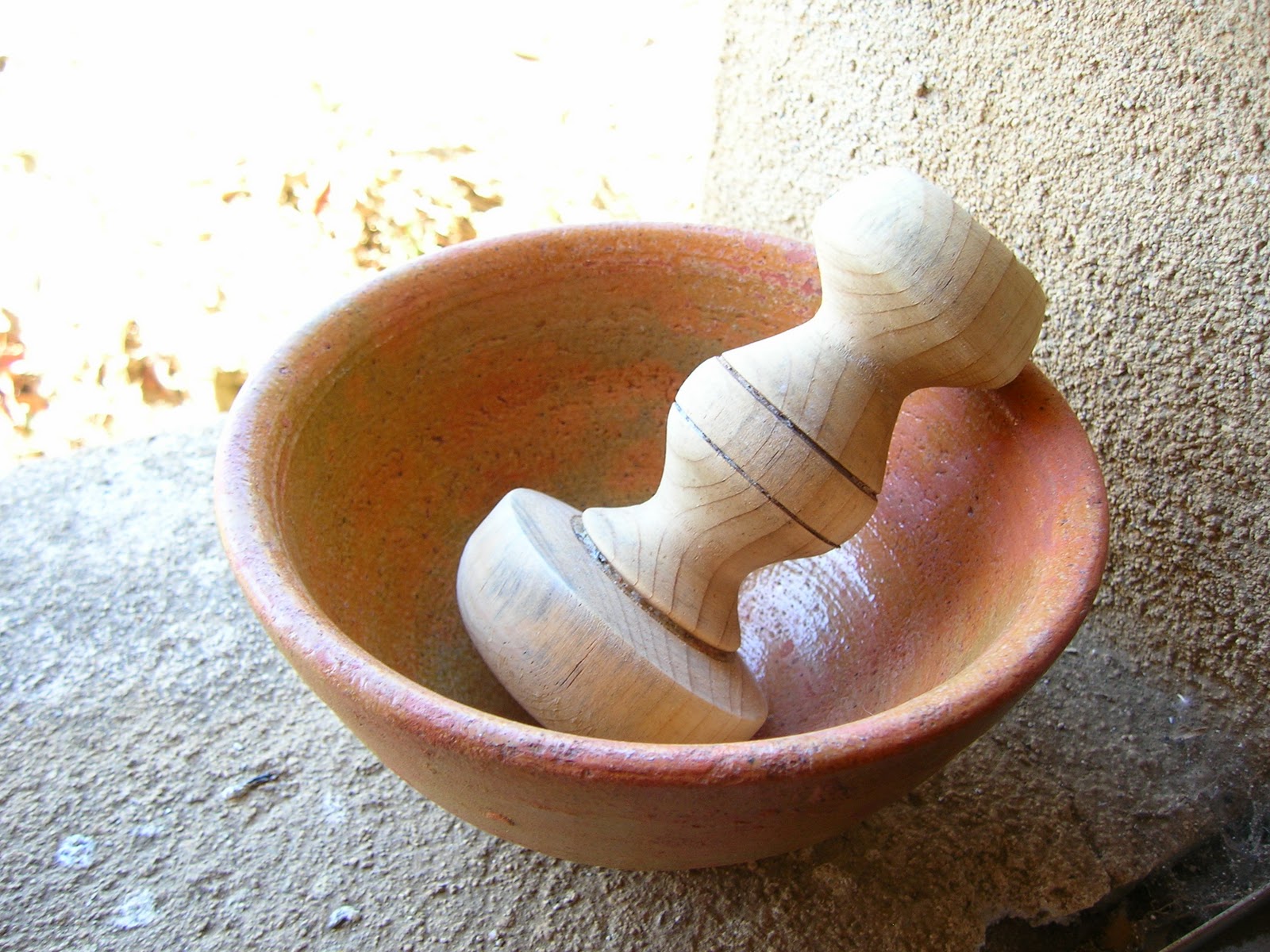
Here's my machucador for mashing tomatoes, and other sauces.

Eggs make an appearance on Guatemalan tables far more frequently than does meat.  In eating with my host families during training and the first few months at site, I probably ate at least one egg a day.  Sometimes it was an egg cooked in soup for dinner.  Sometimes a scrambled egg with tomatoes and onions thrown in for breakfast.  Sometimes a fried egg with chirmol on top, accompanied by black beans and tortillas.

My favorite egg dish quickly became verduras envueltas (wrapped veggies).  My training host mother would whip this out for a lunch or dinner probably once a week, and I always had to hold back from taking a third helping.  It's more or less like a vegetable tempura, and she did it with green beans, cauliflower, and broccoli.  She separated the egg yolk from the whites, and used her electric beater to whip the whites until they were stiff.  Then she added the yolk back in and kept whipping it, so it was still fluffy but had the whole egg there.  Each hunk of cauliflower (or handful of greenbeans) was dipped in the eggy froth and fried in the slightly greased pan.  Once cooked, it was served with (you guessed it), chirmol on top, and on lucky days, a bit of queso fresco crumbled and sprinkled on top.

My site host family has "huevo de comal" in which they beat an egg, add cornflour, and then cook it on the comal as they would a tortilla.  It comes out somewhere between a pancake and a tortilla, and they serve it with chirmol as well.  And, of course, tortillas.


I get my eggs from the cooperative shop nearby;
sometimes brown, sometimes white, always loose in a bag.  

Now that I'm cooking for myself, I still use an egg or two a day.  I'd be concerned about cholesterol, but since I don't really eat dairy or meat in my site, I figure I'm probably not in too bad of shape.  I do a lot of eggs, beans, and tortillas meals, just like I had with my host families.  I haven't mastered how to make chirmol well, but I'm getting there.  I also have been breaking out some recipes from home as well.  I make corn crepes/tortillas about once a week, french toast when I decide to splurge on some bread, and I'm thinking about some egg salad sandwiches soon, too.

Sunday, February 6, 2011

My Mostly Companion

It all started one early morning back during training.  I had woken needing to use the restroom just before 5 a.m., but was unable to do so because someone was in the shower.  Another person got into the shower immediately following the first, leaving me with an uncomfortably full bladder and an irritated attitude.  I hadn’t slept well, and really wanted to take care of things and get back to sleep.  Instead, I was halfway in bed feeling huffy while I tried to listen for my cue to run into the restroom. 

Finally, I gave up on sleep around 6:20, as I needed to be down to the highway and on a bus by 7:00.  I grumpily turned on my light and went to put on some clothing (still awaiting bathroom access).  To my bleary surprise, this is what greeted me.


I wasn’t sure what I was seeing at first.


No, I wasn’t crazy.  One of the host family cats had somehow become a stowaway in an upper shelf of my wardrobe all night long.  It was so strange (and she was so cute) that it broke me out of my funk and made me laugh out loud.  I wasn’t even able to work up anger over the fur she left on my clothing.

That little ball of fur that changed my mood is named Canchita, meaning blonde or light-haired; this is usually applied to foreigners, but can also be used to describe Guatemalans who have anything other than black hair.  Even slight streaks of brown will get locals labeled Canche. 

Right away Canchita had pegged me as a sucker.  She must have learned from the previous two Trainees that Americans are softies and willing to offer pets, laps, and general cuddling in a way that almost no Guatemalans are likely to do.  At first she would sneak onto my lap in the main room, but was soon cleverly escaping the family’s attempts to throw her out of the house at night by entering my room through a hole in the wall between my room and the kitchen.  The family assured me she had fleas, but I saw no evidence of them.

Now, Canchita’s sister, Blanca (meaning white – not the most creative names, eh?) was pregnant and had three little kittens while I was there.  My madre offered me one of them, and said my friends might adopt the others, too.  Admittedly, they were adorable.


I spent plenty of time playing with them (and my host brothers).  I kept putting off choosing, saying I needed to see their personalities.  But when my madre mentioned her plans to keep one of the kittens (who were all male) and give away the adult cats to avoid having more litters in the future, I saw my opening.  If she was going to send Canchita away, she was sending her with me!

So, when I moved to Site, Canchita came too.  She made the trip stuffed into a costal (woven plastic tote bag), and ended up making a smelly mess all over my host mother’s foot in the bus.  She spent the first week and a half hidden under my borrowed bed and I feared she’d never forgive me (or clean herself off properly!).  Of course, she eventually warmed to the change of scene, though is still wary of the kids and dogs.  Now that we’ve moved up to my cottage she can come and go freely by entering and exiting the house through the roof, and accompanies me on my household chores.


When I’m doing laundry, she basks in the nearest patch of sunlight, just on the edge of the shade from the house.


When I head to the latrine she’s got my back, day or night.


If I turn my back, she’ll try to be helpful with the dishes.  In fact, she’ll try to be helpful eating my bread, tortillas, tostadas, and granola if I’m not careful with the pantry.  While she’s been happy with the switch to concentrado (actual cat food), she must still get nostalgic cravings for her pan dulce days.  I’m going to be investing in some more sturdy storage containers.


If it’s napping that needs doing, she’s happy to lead the way.

Overall, I’d say adopting Canchita (well, allowing myself to be claimed by her) has been excellent for my mental and emotional health.  I can talk to her in whichever language I want, she’s a reliable and prompt dinner companion, and helps warm me up on the chilly (occasionally freezing) nights.  Best of all she makes me laugh when it’s tempting to let petty grievances get a little too large in my mind’s eye.  Maybe I sound like a crazy cat lady alone in my cottage anthropomorphizing my little friend, but I'm glad Canchita is my Mostly Companion.


Thursday, January 20, 2011

Taking Care of Business

I’ve often found that the type of restroom amenities (or lack thereof) becomes a popular conversation topic when traveling.  I have friends who have been to Japan who describe not knowing what to do with all the buttons and options for toilet services.  I have stayed in places in Europe where the bathroom was so small I could easily sit on the toilet with my feet in the shower and my hands in the sink.  I have accompanied friends on their first pit stop in the wilderness and coached them through the use of a hand trowel and techniques for using handy rocks, trees, and logs to find a comfortable position to take care of matters (hopefully with a nice view, and a lack of mosquitoes).  At restaurants friends have urged me many times to go use the bathroom, just to check out the décor or ambiance. 

So, it’s no surprise that we in Peace Corps end up talking about our bathrooms too.  We also commiserate over our actual digestive issues in pretty fine detail, but I’ll spare you publishing that.

The first lesson learned in Guatemala, is to always enter a restroom packing your own supplies.

Image from Threadless Tees
I've definitely been in this situation in Guatemala, and like to think I've done Macgyver proud, but still... I do my best to avoid needing to get creative.  


One of the essential tips we received the first night in country was to remember to put our T.P. in the trash can.  This is familiar to most who have traveled in Central or South America, so wasn't much of a surprise.  

Sumpango host family bathroom
I was a little less prepared for learning how to manually flush the toilet when the water is off -- it's a learned skill of throwing water into the toilet from a bucket nearby just so... to make the contents of the bowl go down, and not come out.

Just as throwing T.P. into the trashcan was becoming second nature, I moved to my site, where we use latrines exclusively.  Now every time I go into a bigger town, I have to remember to switch back to the wastebasket, then back to the pit again when I get home.


This is the main latrine that the family compound shares.  Toward the end of November we had a wind storm come through that blew over two of the walls and blew off the roof of this latrine.  The pieces were all more or less propped back into place, but there are gaps in the corners, so people are much more quick to say, "Occupado!" to prevent others from getting too close while they're inside.


The toilet seat in this latrine was painted with limestone, I think to help keep it disinfected?  It tends to have the effect of highlighting whenever someone misses the hole and hits the seat.... happily I now have my own latrine that I can clean when I please.


Some people use their latrines to make their political allegiances known.


My latrine (the one up at my cottage, which I share with the grandfather) is made of adobe.  It's got a roof that slopes down from just about exactly my height to much shorter, so I'm a little scrunched, but hey, it's not like I go there to hang out.  The boards my left hand is resting on are the makeshift door that I can drag across the entrance should I so choose, but I mostly don't bother unless I know someone's nearby.  I prefer the fresh air and the view of flowers growing outside. 


The grandfather uses old newsprint for his toilet paper (above left).  I bring in my own plush Scott roll.  This is one of the things I've decided it's worth splurging for on my Peace Corps budget.  I really don't mind using a latrine, but I do mind newsprint.  There's also a wooden lid for our outhouse (upper right).

When moving into my new place I had to go through a PC housing checklist for safety and security.  One of the requirements for those of us with latrines is to have a cement floor.  I've seen (and used) latrines with wooden floors (or just a few wooden boards to balance on) and apparently there have been cases of boards rotting, leaving unsuspecting users to fall down into the latrine.  This is definitely one regulation I was happy to comply with!


Besides all the infrastructure issues around restrooms, I've noticed some cultural differences as well.  When I go to the public restroom in the mall in Xela or Chimaltenango (these are pretty similar to U.S. malls), the women spread out and stand in lines behind each stall.  In the U.S., the line of women forms at the entrance to the restroom and the woman in the front takes whichever stall is vacated first.  In Guatemala, it's more like choosing a checkout line in the grocery store.  If you choose the one that moves more slowly, tough luck.

There may be a stereotype that U.S. women always go to the bathroom in groups, but I can assure you that when we do, we use separate stalls.  In Guatemala I've seen two or three girls entering a stall together, each taking turns at the toilet.  I don't just mean 5 year olds here... probably up to 13 or 14 year olds.  I'm not saying this is the norm, or very common.  But it's definitely not uncommon.  Odd.

Lastly, for all Guatemalans are said to be indirect communicators, they're surprisingly direct on some topics.  This includes asking if you have diarrhea and if there was enough toilet paper for you to get by (not to mention how much things cost, how much money you make, if you're homesick/sad, why you are single, and so much more... but those are topics for another day).

Sunday, December 19, 2010

Guatemalan Cuisine: Beans


The second most prevalent food in my diet here is beans.  They come in various forms and colors and make a good nutritional pairing with all the corn, as many vegetarians know.  In Sumpango we had almost exclusively black beans, but the beans went through a transformation over the course of each week, with a metamorphosis from enteros to colados or licuados and ending as volteados.  I enjoyed the progression, and found I liked each form more than the last, but was always perfectly happy to start the process over once more. 


Frijoles Enteros  are your basic whole black beans in their own sauce.  They’re made from the dry beans with water, garlic, and onion thrown together in an olla (pot) and set for a long slow cook over the wood-fired stove.  Some use a pressure cooker to speed things along.
 

Frijoles Colados or Licuados start with the Enteros but add in some more garlic and onion that have been sautéed in a pan.  Then everything is put into the licuador (blender) and out comes a smooth liquidy paste.  This can be spread on tostados or served in a bowl as is.  The ones pictured are less liquid than usual; I think this was the 2nd day of reheating them.


Volteados start as licuados and are cooked down in a pan over a burner for about 2 hours, becoming more dry and dense as it goes.  Once they dry out some the beans are flipped in the pan (volteado means overturned or tossed) and form a dense log.  In my view, Frijoles Volteados have the intense flavor and texture in the beans world that cheese logs have in the dairy world.
In my site we haven’t had any volteados, but the first two forms show up on the regular.  We also dip into a wider variety of beans, with red beans, white beans, fava beans and more making their rotation onto the plates.  One kind of bean (I don’t know what it was called, but it was large and green) left me uncomfortably gassy and bloated, but other than that I have no complaints on the abundance of beans.

Whereas corn is a character in every episode (or meal) of the Guatemalan cuisine drama, beans make an appearance just once or twice a day.  I would characterize them as the nosy neighbor or the quirky aunt in the storyline… they come in frequently and fill in the plot but don’t provide any shocking twists in the story (or surprises for the palate).  They are a reassuring repeat character that provides the foil for any guest stars that burst onto the scene.    

Saturday, November 6, 2010

Ch ch ch changes!

Three weeks and two days ago, I was on pins and needles awaiting my site assignment with my three fellow Sumpango Food Security Trainees. I didn’t know quite what I was hoping for, and I was desperately trying not to figure it out, in case that wasn’t what came my way. Upon entering the room I could see which four sites remained to be assigned and despite myself, I knew exactly which one I wanted (despite knowing very little about it). Happily, that’s exactly the folder my APCD handed me! I knew my destiny at last; my home for the next two years was to be an aldea (village) in the department of Sololá!


Two weeks ago I was wrapping up my site visit. I’d met my new host family (who is also my “counterpart” which is my official connection to my host agency in the community) and worked out living arrangements for the immediate future. I’d managed to scrape up a shin on rebar while falling in love with the view from the family’s roof. I was feeling nearly equal parts overwhelmed and hopeful. I was determined to find a teacher for the local language, K’iche’ ASAP. I also realized just how comfortable I’d become with my previous host family… it was time to mentally prepare for a new adjustment period.


One week and a day ago I went to the U.S. Ambassador’s home in Guatemala City, raised my hand, and took the oath that transformed me from Peace Corps Trainee into Peace Corps Volunteer. We scarfed down refreshments, hitched a ride to Antigua, and settled into the Hostel as home base for a day/evening of celebrations… several birthdays, the fact that we’re volunteers, and a bon voyage as we headed to our many new homes. Unfortunately, I came down with some food poisoning midafternoon and got to know the bathroom of my Hostel much better than any restaurants or bars around town that evening. So I spent Saturday in Sumpango to recover and then headed to my site early Sunday morning.


Today I am wrapping up my first “work week” in site. I arrived over the Day of the Dead celebrations, so the start to meeting the community has been slow since everyone was focused on their personal family traditions. I did manage to buy a bed off the back of a pickup truck for less than half the asking price in local stores (hopefully it wasn’t a lemon purchase). I’ve spent many hours sweeping mouse poop and spiders out of the place where I’m hoping to move later this month (I’m safely in a room of the family’s house in the meantime).

We held our first meeting with the women’s group “as a whole” this morning, set to begin at 8:00. The first woman arrived at 8:25 and additional women were arriving until after 9:00. Of the 72 women listed as part of the group, perhaps 25 arrived, and Ela was pleased with the turnout. I have to say, it was a windy morning in the high 40s, so I don’t blame some women for wanting to stay home. I did my best to introduce myself and seem eager to work while managing expectations for just what projects we’ll get going on and when. I was striving for eloquence in Spanish (with middling results) and who knows how I sounded once Ela translated me to Ki’che’ for the women. Regardless, it’s a start!

Sunday, October 17, 2010

Guatemalan Cuisine Casting Call

My first meal in Guatemala was a tostada and a cup of atol.  There were tostadas with either a black bean spread or guacamole and queso fresco (fresh cheese, with a tasty mild flavor and the texture of feta) sprinkled on top.  I was elated.  Avocado always makes me happy, and the atol drink was essentially hot rice pudding with plenty of cinnamon. 

Later I realized that this meal contained the three of the four ingredients that would be both the stars and supporting players in the vast majority of the meals that followed: Corn, Beans, Eggs, and Rice. 

To oversimplify, meals in Guatemala always involve corn, accompanied by one or two of the other three options.  Guatemalans love their salt and sugar and put generous helpings of each in soups and drinks, respectively.  The food is not spicy, for the most part.  For example, salsas in my house are mostly tomato, bell pepper, and (sometimes) onion.  Oil and margarine are popular cooking ingredients, and boiling or frying (or boiling and then frying) are far more common than steaming or baking.  In my house fruits aren’t very common, but we have veggies one meal more days than not.  Meat makes an appearance a few times a week, and cheese or milk shows up once or twice a week.  Unfortunately, avocado hasn’t been all that common, but they are coming into season soon so hopefully they’ll be a frequent guest star when the prices come down. 

This is only my view from my host family, of course.  Some other trainees have commented that they have pan dulce (sweet bread… although not all that sweet) with meals every day, although that hasn’t been the case for me.  In my house the sweet bread is available a couple of nights a week with our hot drinks after dinner. 

Stay tuned for a closer look at the leading characters, guest stars, and extras in the cast of Guatemalan Cuisine.  

Tuesday, October 12, 2010

The Road Less Maintained


One of the first things that struck me when I first arrived to Sumpango was an erosion issue. Maybe it was because weeks before heading to Guatemala my dad and I went backpacking and found ourselves critiquing the trail maintenance every half mile or so (occasionally stopping to play Army Corps of Engineers). Maybe it was the fact that when I got dropped off at my host family’s house we got the rear wheel drive Peace Corps minivan stuck in the mud ruts in the road on the way to my house. We eventually needed assistance from the men driving the 20 ton trucks on either side of us to get out enough to retreat to the last paved corner, leaving me to hoof it the final few blocks. In any case, there is a huge amount of neglect and erosion in the roads on the outskirts of town (where I live) that seemed so unnecessary to my outsider’s eyes. Just an adjustment here to divert the ever present run off from the rain, and voile, problem contained (not solved of course, just hugely improved).

Rains really do a number on this road

Why isn’t this being addressed? When I first arrived in Guatemala I was pleasantly surprised by the quality of the highways. Admittedly there are only two paved roads I’ve found in Sumpango, but the majority of streets are made of either adoquines (interlocking paving stones) or cobblestones.

This road leads down from my neighborhood

Is it the tragedy of the commons? Almost certainly. If you check out the litter getting turned up by the erosion it’s clear that this isn’t the only area where that’s the case. But why isn’t the local government maintaining the roads? After all, one of the roles of government is to take care of the tragedy of the commons. Guatemala does have a relatively low tax burden, so maybe there aren’t the funds to get them paved or even to dig a drainage ditch. On the other hand, maybe the people living in this neighborhood just don’t have enough cuello (pull or influence) to make it up the priority list. On a third hand, perhaps the people in the neighborhood don’t even see it as a problem, because their priorities and standards of living go in a different direction. Maybe they worry more about the water getting turned off frequently. Maybe they are more concerned about getting mail service more regularly, or would prefer improved security after dark. It may even be that the culture here deemphasizes expectations of progress and improvement to the point that my asking about it would bring on more confusion than explanations (although in the case of my host family, I doubt it).
There is some construction work to add more adoquines to one road near my home.

This is just one more detail that sticks out to me like a sore thumb, probably because I am still learning to see the full picture. I feel like the proverbial blind man with only one part of an elephant within reach.
This road is a little further out of town than my place, and has eroded until the water pipe leading to the neighborhood is exposed.  Four wheel drive is definitely required to make it through this beauty.

Tuesday, October 5, 2010

Recipe: Naomi’s Chicken Empanadas

When I returned back to Sumpango after Field Based Training, my 12 year old host sister had volunteered to make dinner based on a recipe she had learned at school earlier that week.  Since my parents were heading out on an errand, I jumped in to help in the assembly line of making them.  Although a labor and time intensive process, we got our reward when the younger brothers nominated us to continue cooking the rest of the meals this week. 

The basic pattern of this meal matches that of a lot of meals I’ve had here; make a dough (usually corn based), make a filling, tortillar (verb meaning to make into tortillas), combine, fry.  Here’s the step by step with a little more detail:

Filling:
Chicken breasts on the bone (boil, then disminusar by picking meat off bones and shredding)
Bell pepper (chopped finely)
Onion (shredded or chopped finely)
Mayonese (just enough to moisten the other ingredients)

Masa or Dough:
White flour (one cup)
Milk (one cup)
Margarine (one stick)
Salt (just a pinch)
Baking Powder (one teaspoon)

Directions:  Combine ingredients for dough and knead.  When it has achieved a good consistency, pull out balls of dough and roll with a rolling pin into a thin tortilla a little bigger than your palm.  Fill the tortilla with a tablespoon full of filling.  Fold over the dough, pinch it shut and seal it with the tines of a fork.  Fry the empanada on both sides in vegetable oil until golden brown.  Serve hot, with tomatillo sauce (optional).


Tuesday, September 28, 2010

FBT: Jalapa

Last week I went east to the department of Jalapa for Field Based Training with the other seven Food Security PCTs.  We used Mataquesquintla (a town nicknamed Coliz, oddly enough) as home base and headed out to a variety of surrounding aldeas (villages) during the days to get a taste of what some real current FS PCV sites look like.  Highlights follow.

Sunday:  We took a half day road trip starring a food court in Guatemala City that included standards from home like Subway and Burger King.  This started the week long trend of being bottomless pits meant to absorb any food in sight.

Monday:  Chicken vaccinations in San Antonio Las Flores by morning, touring a Coffee Co-op in Los Magueyes for the afternoon.  It turns out injections with a syringe are much less emotionally scarring than stabbing a chicken in the wing with a lancet.  The Coffee folks had a truly impressive worm compost system, but I was less enamored of the actual coffee (not that I know coffee quality anyway).


Tuesday:  I came down with a fever on Monday night that plagued me all day Tuesday, leaving me less than peppy.  We observed a cheese making process at the lecheria (diary) in Soledad Grande, had a devastatingly good lunch at the local PCV’s host family’s house, and toured some family gardens she has helped start.  Even though I was under the weather, this site appealed to me way more than Monday’s did.  Something about being high in the mountains just always makes me happy.


Wednesday:  We spent the morning in Pino Dulce making lunch with a women’s group who works with our PCV guide.  Since my portion of the meal needed to boil awhile, I also got to bond with the kids of the household, playing some a nameless game similar to Duck Duck Goose.  The afternoon was a quick stop by a school garden for another example of current projects, and then we returned to the hotel to prep our charlas for Tuesday (chats or workshops).


Thursday:  Charla day.  All eight of us had 30 minute presentations to give, which made for a long day.  The morning group was a cluster of women in San Supo who were eager to participate and pretty savvy to the topics.  For the afternoon we went to Pino Dulce’s ecological park where I gave my charla on soil conservation to a very shy group of young men that are employees at the park.  They enjoyed my “Lluvias de cambio” / “Rains of change” game (that’s Winds of Change to you, FLBC-ers), but were stone cold when I asked for questions or comments.  Ah well, the people evaluating me seemed to think it went okay.  We spent the evening around a campfire playing a marathon series of Mafia games (cards) and slept in a cabin perched on the edge of a steep mountainside.

Friday:  After breakfast we had a class on soil conservation methods that was both theoretical and practical, which actually reinforced my own talk from the previous day pretty well.  We hiked down a steep valley and constructed some A-frame levels, drainage ditches, and discussed terracing.  After a humbling (gasping and wheezing at 8,000 feet) climb back up to the park entrance, we had a delicious lunch and jumped into the vans for Sacatepequez (our department during training). 


We returned a day early due to Tropical Storm Matthew heading our way, but I was tired enough to get over my disappointment at missing out on zip lining fairly quickly.  Plus, we got to stop at Wendy’s and buy a Frosty on the way home.  It’s funny how I love American fast food here, but never ate it while I was home.  Go figure.