Wednesday, December 29, 2010

To Make a Tamale

In mid December, Tia Cata had a big party to break in her new building / party room that had just finished with construction.  For this party, Ela was recruited to make 400 tamales, to feed the horde after the church service wound down.  This was a several day process to prepare, and I did my best to document each step.  I missed a good chunk of preparation of the recaldo (sauce) because the family dog bit me and I had to head to the doctor for an anti-rabies shot, but that's a story for another day.  

Anyway, here are the steps I was able to follow.  I apologize that I don't have the actual quantities available, but none of you need to make this in quantities of 400, I suppose.  Besides, I think it's mostly made to taste... a handful of this, a few pounds of that.... you get the idea.

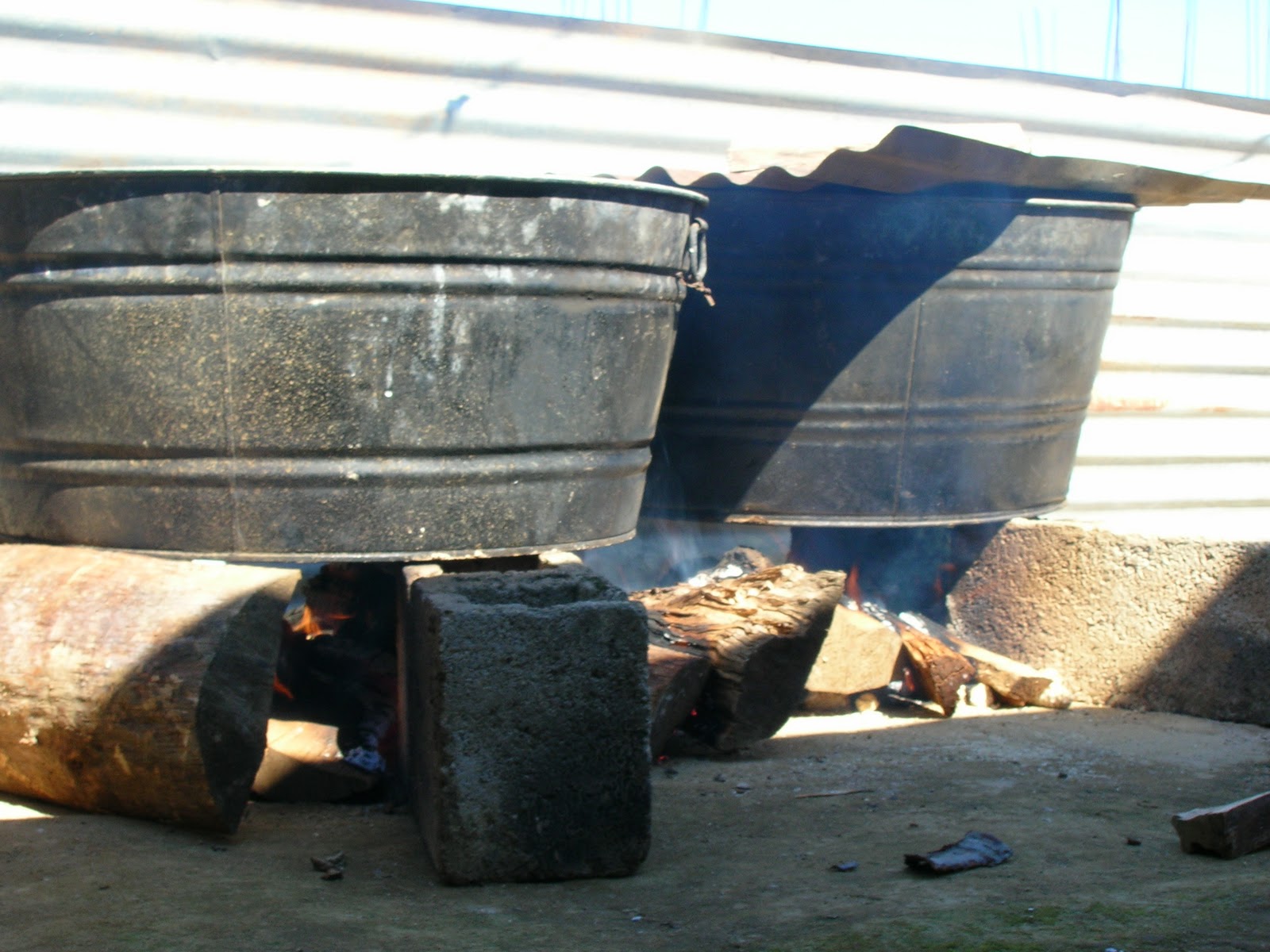
For such quantities, a makeshift cook space was made.  Cement blocks raised the metal basins off the fire, and a fence of lamina  was set up to shelter the flames from wind.

As with most things, the process started with corn.  On Thursday it was set to nixtamal, or soak in limestone and water to soften the kernels enough to take them to the molina (grinder / mill).  

After cooking the corn it gets taken to the mill (the next day, Friday morning).  Here I get hazy, but I think they cook it again with water added, as well as some cooked rice (a relatively small portion of the total) to make it more smooth and white.    

Ela then strained the liquid to take out all the bits of grit from the corn kernels.

Lots of consome (bullion, I think... some kind of powdered broth), margarine, and salt were added in (with many a taste test to be sure the balance is just right).  

And it returned to the fire, for constant stirring.

We started to take turns as the masa thickened and made stirring more tiring.

Finally, it began to boil like the mud pits in Yellowstone.

When we could drop a glob into cold water and have it keep it's shape, we knew it was ready.
Here's the sauce.  I missed the making of this goodness, but Ela told me it's loads of tomatoes, some red bell peppers, two kinds of ground pepper, cinnamon, and a little chocolate.  They must have taken this to the mill too, because I don't want to think how many blenders full this would have been.  I think it was strained as well, because I didn't find any seeds.

Ela removed the chicken skin and chopped the meat into chunks, cutting right through the bone with a knife reinforced by a wooden bat to give a little extra force when needed.

And it landed in yet another big tub.

While Ela was on meat duty, she had a neighbor girl cut exactly 400 strips of bell pepper.  That was how we kept track of when we met our goal.

Meanwhile I counted out 865 raisins by hand, to find out how many we had, and thus how many could go in each tamal.  I know there was an easier way to do this... perhaps count 50, weight them, and then estimate from there.  Too bad.  This is how we do it here.

Sorry the picture's blurry, I must have been too cross eyed to notice.   
Some leaves were washed and cut small to be the inner leaf; perhaps a plate sized option to remove the tamal from the main wrapping?

The main leaves had also been washed and had their stems removed.
At last, all the ingredients prepared (Saturday, day three of the process at this point...), we started to assemble.  The chicken was in the sauce, the masa cooled and doled out onto the waiting leaves....

...the decorative pepper and raisins placed just so....


...wrapped, folded, and stowed into another basin.
They return to the fire, with naked corn cob (stripped of kernals) and water in the bottom to prevent scorching and plastic on top to retain steam.  Two hours to go.  

At last, the fruits of our labor made it to a plate.

I have to admit, the "decorations" didn't make it look all that lovely...


....but the taste was great!  The texture was unlike any I've tried before; I wouldn't have said it was corn if I hadn't already known.  And, while there are other styles of tamales here that don't get strained and keep that cornmeal texture, this is the fancy party way.  
And that, folks, is the three day ordeal to generate 400 tamales.  Like I said, 50 for Noche Buena?  No sweat.  ...But this isn't something I want to whip out on a weekly basis.

Monday, December 27, 2010

Feliz Navidad!

Christmas in Guatemala seems to emphasize the 24th over the 25th.  Actually, in my site we emphasized the time immediately before and after midnight between the 24th and 25th, leaving the rest of the holiday mainly quiet.

The 24th was a relaxed day at home.  I spent the morning as a busy elf secretly putting the finishing touches on some decorative garlands that I made for the extended host family.  I didn't have much money (or much of an idea what to spend it on), so I figured a little time and craftiness would go over just fine with the grandparents, aunts, and uncle.  

My gift garlands, hanging over my bed/workshop.  I told them the stars symbolized the star the Wise Men followed to Bethlehem, and that paper cranes are a symbol of peace (and my wishes for the New Year).  
In the afternoon we did a little decorating, such as placing the nacimiento (nativity scene) under the Christmas tree and spreading pine needles all over the front steps and patio (pine needles all over the ground is a must at any Guatemalan celebreation; birthday, wedding, graduation, you name it).  I helped Ela make 50 tamales, which was a breeze after the 400 from two weeks ago.  

Elkin (left) and Hendrick (right) posing around the tree and nativity scene.  Mary got broken right after lunch... Benancio came in and joked that, "Elkin ya tiene un pecado," (Elkin's got a sin already) because Mary was in three pieces.  We carefully balanced them together (no glue) and just tried not to touch the scene.  
As the evening wore on and the sun went down, the power went off.  The previously festive blaring and clashing music (both pop hits from the radio and whining tin sounding holiday tunes emanating from blinking Christmas lights) disappeared, and the town went quiet.  Ela started wrapping the kids presents by candle light out on the patio, while the kids watched and carried each gift off to set under the tree as she finished the wrapping.  Since they had been along on the shopping expedition, there was no need for secrecy.  I think they had already opened and started playing with more new toys than they ended up unwrapping later on... In the end the gifts from Tia Isabel and me were the only surprises.  

The power eventually came back on around 9:30 p.m., which was good because we were all getting drowsy by candlelight.  We had to make it to Midnight, that's when the celebration actually gets going!  To await the hour, we dug into the tamales (two kinds, yum!), hot chocolate, magdalena cake, and ponche (hot drink sort of like cider; they throw a mix of dried fruits that come pre- sugared and spiced with cinnimon into boiling water and voila!).  We also lit off a few small fireworks and sparklers to pass the time.  Well, Benancio and Hendrick lit them, lighting the fuse with the firework still in hand and throwing it to the ground at the last minute.  I stood safely to the side and enjoyed the show.

Ela's makeshift stove in the patio, heating ponche, tamales, and hot chocolate.  
At a few minutes before Midnight, the valley either could just not wait any longer, or had their clocks set just a bit faster than mine.  The entire valley (ringed by several aldeas and a pueblo) erupted.  I'm not sure I've ever experienced fireworks in quite that way -- one PCV friend texted me at midnight saying, "welcome to Apocolypo Christmas."  It was like all the fireworks a medium sized city in the U.S. lights off over the whole week of 4th of July packed into half an hour starting at midnight!  I took a video, and though my camera doesn't capture most of the visuals, just listen to the constant booms and pops and you'll get an idea of what I was experiencing.   


Toward the end you can hear Hendrick shouting, "Y ahora es tiempo de abrir regalos!" ("and now time to open presents!").  So, even though he knew exactly what he was getting, his enthusiasm for opening the presents seemed undiminished.  

Tio Oscar rolling out 25 meters of firecrackers.

One of the former volunteers in my site observed to the family (and they repeated to me): En Guatemala, no hay dinero para comer, pero si hay para quemar! (In Guatemala, there isn't money to eat, but there is money to burn!).  Once we had taken in as much explosions as we could handle (about half an hour later... the bursts showed no signs of stopping), we all trooped downstairs.  We all hugged and said Feliz Navidad,  opened presents, and had a second round of tamales.  I snuggled into bed around 1:30 a.m.  

My Chirstmas Corner of the room -- no tree, unfortunately.  
On Christmas day itself I had a Skype date with my family and participated in the round robin of opening presents, since my overly generous family had managed to send me plenty of packages (some of which are still on their way).  They munched on our traditional almond danish puff, I munched on more tamales.  The internet went out midway through, but it was enough to be able to kibitz with them some and share laughter.  I read Charles Dickens' A Christmas Carol, which I'd found at the Peace Corps Office, and streamed holiday music from NPR's website.  We got back in touch later in the day to finish catching up and to fill one another in on the presents opened after we lost the connection.  

All in all, I enjoyed Christmas in Guatemala!  It's easier to escape the commercialization of the holiday when your town is more or less outside of the formal economy.  It was strangely fairly secular here, which I wouldn't have expected.  I missed some of my own traditions, and certainly always love having a White Montana Christmas, but it was a blast to see the excitement of my Site family when the fireworks started, and I was reduced to giggling, hopping and pointing with glee.  I hope the holiday was joyful for all of you -- whether full of old traditions or the beginning of some new ones!
Sunday, December 19, 2010

Guatemalan Cuisine: Beans


The second most prevalent food in my diet here is beans.  They come in various forms and colors and make a good nutritional pairing with all the corn, as many vegetarians know.  In Sumpango we had almost exclusively black beans, but the beans went through a transformation over the course of each week, with a metamorphosis from enteros to colados or licuados and ending as volteados.  I enjoyed the progression, and found I liked each form more than the last, but was always perfectly happy to start the process over once more. 


Frijoles Enteros  are your basic whole black beans in their own sauce.  They’re made from the dry beans with water, garlic, and onion thrown together in an olla (pot) and set for a long slow cook over the wood-fired stove.  Some use a pressure cooker to speed things along.
 

Frijoles Colados or Licuados start with the Enteros but add in some more garlic and onion that have been sautéed in a pan.  Then everything is put into the licuador (blender) and out comes a smooth liquidy paste.  This can be spread on tostados or served in a bowl as is.  The ones pictured are less liquid than usual; I think this was the 2nd day of reheating them.


Volteados start as licuados and are cooked down in a pan over a burner for about 2 hours, becoming more dry and dense as it goes.  Once they dry out some the beans are flipped in the pan (volteado means overturned or tossed) and form a dense log.  In my view, Frijoles Volteados have the intense flavor and texture in the beans world that cheese logs have in the dairy world.
In my site we haven’t had any volteados, but the first two forms show up on the regular.  We also dip into a wider variety of beans, with red beans, white beans, fava beans and more making their rotation onto the plates.  One kind of bean (I don’t know what it was called, but it was large and green) left me uncomfortably gassy and bloated, but other than that I have no complaints on the abundance of beans.

Whereas corn is a character in every episode (or meal) of the Guatemalan cuisine drama, beans make an appearance just once or twice a day.  I would characterize them as the nosy neighbor or the quirky aunt in the storyline… they come in frequently and fill in the plot but don’t provide any shocking twists in the story (or surprises for the palate).  They are a reassuring repeat character that provides the foil for any guest stars that burst onto the scene.