Sunday, January 30, 2011

Making a House a Home

This weekend I had my first house guests, as I had a mini cottage warming party with four good PCV friends. I've been in my new place just over a month, and the work back in November and December sweeping, disinfecting, and adding fresh coat of paint certainly helped brighten the mood.  Moving in was a relief, and my kitty (to be profiled later) helped make the place feel lived in.  Still, there's nothing like some good laughter and companionship to make a place feel really one's own.  

Friday two of the crew arrived and we made mango curry for dinner.  Breakfast the next morning was pancakes and hash-browns.  Once the other two arrived, we hiked up to the cemetery to enjoy the view and a picnic of granola-tacos (tortillas with peanut butter, granola, and honey inside: delightful).  After a trip to the neighboring town to pick up supplies, we entertained ourselves by producing large and scrumptious meals for dinner (tostadas with spicy bean dip and mango tomato salsa, home made macaroni and cheese) and breakfast (french toast with mango sauce, hash-browns, scrambled eggs).  

We probably spent most of our weekend preparing, consuming, and cleaning up after our culinary adventures, with a movie huddled around my laptop thrown in for good measure. I suppose the opportunity to pool our resources and eat some gringo food after all those beans and tortillas was too good to pass up.  Last night we had three in my bed (plus one cat), and two on a futon-ish mattress on the floor with sleeping bags and shared blankets for a cozy night indeed.  

On the way down from the cemetery we found some wheat just after harvest (a fairly uncommon crop) and played farmhand for a photo.  (Our 5th companion is taking the photo, of course).
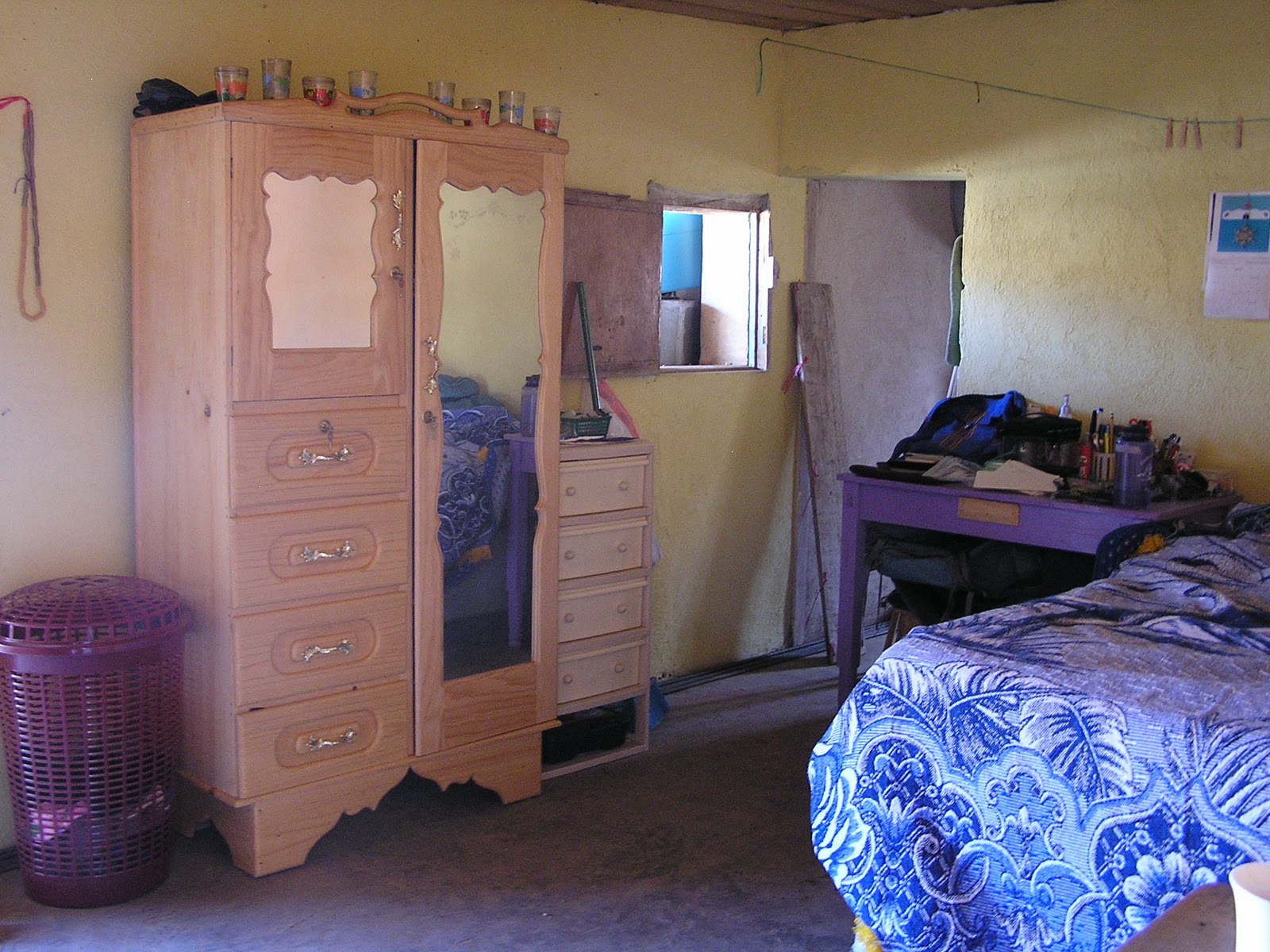
Below are the long promised shots of my pleasant little place, well spruced up with the many items I was able to buy for a one-price-fits-all screaming deal off another volunteer who ended up leaving Guatemala early.  Many times over the weekend I was asked "where'd you buy this?" and I would respond, "I inherited it..." to my companions' increasing envy.  The shots start in my cooking corner and rotate clockwise around the room (skipping the doorway).  

Kitchen.  Where the magic happens.

Rest of kitchen, and mud room... er... bench.

Wardrobe, bath, and laundry room area. 

Bed.  Not made due to a sleeping feline.  Please excuse.  

Office + Refrigerator space.
Look!  I have a microwave!  Not something I'd ever have imagined in Peace Corps or considered purchasing for myself, but since it came with the rest of the furniture.... I mean, I didn't even have one of these in the states for a good while there!  I think I've used it four times, so far.
The room is pretty spacious, and allows me to feel like I have a separate sleeping area from cooking, with my little office-y spot in between.  The door behind the oven leads to the grandfather's office (but we don't use that door, clearly), and the door to the left of my bed leads to a storage room that I don't have rights to use.  I just keep the door open to let a little more natural light through from the other little window.

Thursday, January 20, 2011

Taking Care of Business

I’ve often found that the type of restroom amenities (or lack thereof) becomes a popular conversation topic when traveling.  I have friends who have been to Japan who describe not knowing what to do with all the buttons and options for toilet services.  I have stayed in places in Europe where the bathroom was so small I could easily sit on the toilet with my feet in the shower and my hands in the sink.  I have accompanied friends on their first pit stop in the wilderness and coached them through the use of a hand trowel and techniques for using handy rocks, trees, and logs to find a comfortable position to take care of matters (hopefully with a nice view, and a lack of mosquitoes).  At restaurants friends have urged me many times to go use the bathroom, just to check out the décor or ambiance. 

So, it’s no surprise that we in Peace Corps end up talking about our bathrooms too.  We also commiserate over our actual digestive issues in pretty fine detail, but I’ll spare you publishing that.

The first lesson learned in Guatemala, is to always enter a restroom packing your own supplies.

Image from Threadless Tees
I've definitely been in this situation in Guatemala, and like to think I've done Macgyver proud, but still... I do my best to avoid needing to get creative.  


One of the essential tips we received the first night in country was to remember to put our T.P. in the trash can.  This is familiar to most who have traveled in Central or South America, so wasn't much of a surprise.  

Sumpango host family bathroom
I was a little less prepared for learning how to manually flush the toilet when the water is off -- it's a learned skill of throwing water into the toilet from a bucket nearby just so... to make the contents of the bowl go down, and not come out.

Just as throwing T.P. into the trashcan was becoming second nature, I moved to my site, where we use latrines exclusively.  Now every time I go into a bigger town, I have to remember to switch back to the wastebasket, then back to the pit again when I get home.


This is the main latrine that the family compound shares.  Toward the end of November we had a wind storm come through that blew over two of the walls and blew off the roof of this latrine.  The pieces were all more or less propped back into place, but there are gaps in the corners, so people are much more quick to say, "Occupado!" to prevent others from getting too close while they're inside.


The toilet seat in this latrine was painted with limestone, I think to help keep it disinfected?  It tends to have the effect of highlighting whenever someone misses the hole and hits the seat.... happily I now have my own latrine that I can clean when I please.


Some people use their latrines to make their political allegiances known.


My latrine (the one up at my cottage, which I share with the grandfather) is made of adobe.  It's got a roof that slopes down from just about exactly my height to much shorter, so I'm a little scrunched, but hey, it's not like I go there to hang out.  The boards my left hand is resting on are the makeshift door that I can drag across the entrance should I so choose, but I mostly don't bother unless I know someone's nearby.  I prefer the fresh air and the view of flowers growing outside. 


The grandfather uses old newsprint for his toilet paper (above left).  I bring in my own plush Scott roll.  This is one of the things I've decided it's worth splurging for on my Peace Corps budget.  I really don't mind using a latrine, but I do mind newsprint.  There's also a wooden lid for our outhouse (upper right).

When moving into my new place I had to go through a PC housing checklist for safety and security.  One of the requirements for those of us with latrines is to have a cement floor.  I've seen (and used) latrines with wooden floors (or just a few wooden boards to balance on) and apparently there have been cases of boards rotting, leaving unsuspecting users to fall down into the latrine.  This is definitely one regulation I was happy to comply with!


Besides all the infrastructure issues around restrooms, I've noticed some cultural differences as well.  When I go to the public restroom in the mall in Xela or Chimaltenango (these are pretty similar to U.S. malls), the women spread out and stand in lines behind each stall.  In the U.S., the line of women forms at the entrance to the restroom and the woman in the front takes whichever stall is vacated first.  In Guatemala, it's more like choosing a checkout line in the grocery store.  If you choose the one that moves more slowly, tough luck.

There may be a stereotype that U.S. women always go to the bathroom in groups, but I can assure you that when we do, we use separate stalls.  In Guatemala I've seen two or three girls entering a stall together, each taking turns at the toilet.  I don't just mean 5 year olds here... probably up to 13 or 14 year olds.  I'm not saying this is the norm, or very common.  But it's definitely not uncommon.  Odd.

Lastly, for all Guatemalans are said to be indirect communicators, they're surprisingly direct on some topics.  This includes asking if you have diarrhea and if there was enough toilet paper for you to get by (not to mention how much things cost, how much money you make, if you're homesick/sad, why you are single, and so much more... but those are topics for another day).

Thursday, January 13, 2011

Ashes to Ashes

Last weekend I went to my first burial in Guatemala. 

As I was on my way out of the compound Sunday morning, Isabel and I were making small talk.  I told her I was going out for a walk to take some photos of the aldea.  She mentioned there was a funeral going on up the road for a 12 year old boy who died recently, but didn't know how he had died.  

When I ran into Ela on the street later that morning I asked her if she knew the story, and she said that the boy had eaten a golosina (sweet… usually something like gummy bears) and it got stuck in his stomach.  His stomach got distended and hard, and he had to have surgery.  The surgery didn’t go well, got infected, and he died.  She asked if I’d like to go to the burial that afternoon, and I said I would.

Around 1 p.m. we started walking up the road with a group of women.  The main procession had already left, so we took a shortcut up to the highway to meet them at the entrance to the cemetery.  It seemed like most of the community had turned out.  The casket was being carried by a handful of men, and surrounded by men walking ahead and behind it.  Behind all the men came the women (and some children), walking together, many with shawls over their head.  We slipped into the crowd of women and continued up the hill into the cemetery.  The mood was fairly quiet, without much socializing, but there were no wailing family members in sight (as I have seen in other funeral processions here).

Once there, people spread out.  Some took seats on top of burial mounds (whether of their own family or not, I don’t know).  Others found spots in the shade, and several dozen people crowded around the grave itself.  Some opportunists made their way through the ground toting coolers full of ice cream and popsicles for sale, and found a steady stream of customers.  Someone by the grave (I assume a pastor) stood up to give some words, but all but those closest to him were chatting to their neighbors.  It felt like a subdued picnic.

Ela turned to me and explained that “they say” when they dug the grave for the casket, the found the remains of someone else in that spot and pulled it out.  They don’t know who it was.  Ela confessed she wanted to get a look at what was left of the cranium, and laughed at herself. 

I moved closer to the grave as they lowered the casket into the ground.  Then a group of men immediately covered it over using hoes they had brought for the purpose, and women carried over several big jugs of water to throw on top as all the soil was replaced.  They worked the water into the soil to be able to form a solid mound shape out of what would otherwise have been dust, thanks to the dry season. 

With that, the crowd broke up and started to return home, to pick up their daily rhythm.  I never did get an idea of who the family members were.  On the way down the hill, Isabel and Ela chatted to one another comfortably about death.  They expressed the naturalness of death, and that what God wills happens, there’s nothing we can do.  God knows the time He will call each of us home, and we can only accept that.  It’s one of the only times I’ve heard my new family discuss God or religion.

What struck me most about the situation was how no one seemed particularly conflicted over the death.  Admittedly, I did not attend the funeral itself and I make no claim to know how the family itself felt or dealt with the situation.  When both Isabel and Ela told me of the situation, I expressed how tragic the circumstances were to me, how awful it would be to lose a 12 year old son.  They both agreed with me, but didn't seem terribly moved themselves. 

Perhaps it comes from the fact that in the U.S. it is very rare to lose a child, and we have an expectation that medicine can and should be able to fix most things.  Car accidents, heart attacks, and very occasionally violence result in sudden deaths in the U.S., but rarely would a digestive problem or a fairly routine surgery be viewed as life threatening.  Here, it seems that death from violence is almost common place (though no less tragic for the families affected).  Accidents on the road are also frequent, and more likely to be fatal than in the U.S. because the use of seat-belts is rare (even when they are present), landslides are common, drunkenness a factor, and vehicle maintenance laughable.  I'm not saying Guatemalans are callous, but they may develop a culture of acceptance as a coping mechanism.

Like so many things, this probably comes down to expectations.  In the U.S. many of us more or less expect that we and everyone in our family will make it to old age, and hope we will do it gracefully.  When we or someone we know loses someone in a way that feels out of order -- whether from illness, accidents, or violence -- we are shocked.  We feel cheated, we feel wronged by life.  We tell ourselves and each other, "This isn't how it's supposed to happen."  

Guatemalans not directly affected by a death seem much more likely to react by saying, "Well, these things happen."


I didn’t feel comfortable bringing around my camera during a burial (little did I know there would be vendors working the crowd!) but I have some shots of the local cemetery and the Sumpango cemetery from previous visits.    

Decorations during Day of the Dead: The graves of a sibling of Benancio that never made it to adulthood, and a baby of Cata that didn't make it.  

The view down the valley from the cemetery.  There are no markers on the graves; you just have to know under which mounds your own family members are buried.  Perhaps this is why they accidentally dug up someone else's grave in preparing for the funeral this weekend.

In the larger (and wealthier) Sumpango, the mounds had crosses marking their place, although often still did not always include a name.  (Photo credit: Sara Shapleigh)

More than half the cemetery in Sumpango was given over to brightly colored mausoleums that could hold up to a dozen family members.  Some had chapels stuck in the sides, and many had flowers or other decorations around.   The distinction between the burial styles is a matter of financial means, not of religion.  (Photo credit: Sara Shapleigh)